Blog

Reclaiming Land for SF’s Japantown and Fillmore

During the 1950s, the San Francisco Redevelopment Agency bulldozed and evicted Japanese and Black families and shopkeepers, called “blight,” to widen Geary Boulevard, divide the two communities and build the corporate Japan Center Mall. Japantown, originally 40 blocks in size, shrank to 14 blocks during WW2 and to 4 blocks due to urban renewal, which James Baldwin aptly called “Black removal.” My family’s store was relocated several times on Buchanan St. See History at: nbstore.com

Today, Japantown and the Fillmore have an opportunity to reclaim their land and plan their futures, thanks to a new federal planning grant. With the new Dept. of Transportation grant, I envision a Geary Blvd. underpass to create a 3-block long plaza connecting the two communities with shops, gardens, affordable housing and entertainment space, as I explore in my “Solar Jive” novel. https://a.co/d/eAMpz09

Aimedis Virtual Hospitals

October 9, 2023

Aimedis.com, where I’m CSO, has launched its Virtual Hospitals using the Unreal 2.5 Engine. Our hospitals will initially offer online training to show how VR and AR are used for medical surgeries, taught by Dr. Shafi Ahmed, the first doctor to use VR/AR for surgery. Take a look at our virtual hospitals and let me know if you would like more information: smtatsuno@gmail.com

Our first virtual hospital demos:

Tokyo: https://youtu.be/wbTBj5aUQjM

UAE: https://www.youtube.com/watch?v=Alzod8OrUOY/

Australia: https://youtu.be/eNpHXO-aWmw

Generative AI + The Metaverse

June 9, 2023

Generative AI has totally changed “Everything, Everywhere, All At Once,” like this year’s Oscar winning film. Besides dozens of instant GenAI tips, cheat sheets, classes and schools, people are asking: What will be the impacts? How will I be affected? What should I do? This period reminds of 1994 with the rise of the commercial Internet, except it’s moving faster since more people are online.

Business AI: This one is a no-brainer. Forbes recently surveyed executives and found that 70% plan to use GenAI to streamline their operations and reduce costs. The key areas will be identifying potential problems, threats, supply chain bottlenecks and likely competitors. ChatGPT content is old, limited to November 2021, so it’s great for summaries and fast coding, but not recent analyses or forecasts.

Training and Education AI: Employees and students are already using the many GenAI tools for everything, but its major value is as a tutor to structure and organize existing content into a skeleton of knowledge, even though the details and facts may be wrong or distorted. However, its speed allows for rapid iterations.

Climate Action AI: My focus is climate where I see major rethinking and restructuring the way we view, analyze and prepare for climate chaos and disasters. Instead of passively waiting for bad news, we will be running what-if scenarios, especially worst-case scenarios from all possible perspectives to avoid missing major issues. Since ChatGPT merely summarizes existing content, it is viewed as a neutral compilation of ideas, even though embedded biases tilt it toward business-as-usual (BAU) and activist disaster scenarios, with less subtle variations among various communities. For example, how would families change their choice of lifestyles and residence due to wildfires? But a climate AI boom is coming. Why? Some $120+ trillion in ESG (Environmental, Social and Governance) funding is sitting on the sideline due to greenwashing and awaiting clear rules. Once they are established, innovators will race to attract capital.

Metaverse AI: This is the big question mark among VR/AR creators since GenAI is such a game changer. One of my startup, Aimedis.io, has used AI avatars for personalized medicine in Europe since 2017, which is very fast and convenient for doctors and patients. With VR/AR, avatars could be 3D; with GenAI, you could talk to it and get answers or program it to represent you. Useful 3D applications are mostly in the enterprise, such as AEC (Architecture, Engineering and Construction), medicine, and corporate training, with consumer use cases still limited to gaming and some STEAM (STEM + Arts) education.

Where will GenAI take us this year? My bet is that the 2,300 new GenAI startups will flood and confuse us, but most users will stick to the top two or three, so startups will have to focus on niches to survive the coming market shakeout. ChatGPT, Bing and LifeJourney will be leaders, with Google, Apple, Samsung and other tech giants trying to get into the game. We’ll see lots of mergers and acquisitions (M&As) as the market quickly consolidates since GenAI is moving in real time. ChatGPT hit $30 billion valuation in 6 weeks, which used to take up to 10 years in the past, so expect many unicorns this year and in 2024.

——

Dreamscape Global focuses on imagining and designing the future by combining VR storytelling, urban and environmental planning, and VR visualization and digital twins.

Let’s invent a better world together!

Contact: smtatsuno@gmail.com or sheridan@dreamscapeglobal.com

Cities as Climate Leaders

Dreamscape Global is now promoting the development of “Healthy Cities for Healthy People” due to our global need for solutions to pandemics, high energy and food prices, climate disasters, recession, and the search for new green jobs for the billions of young people coming into the workforce. Not easy tasks at all.

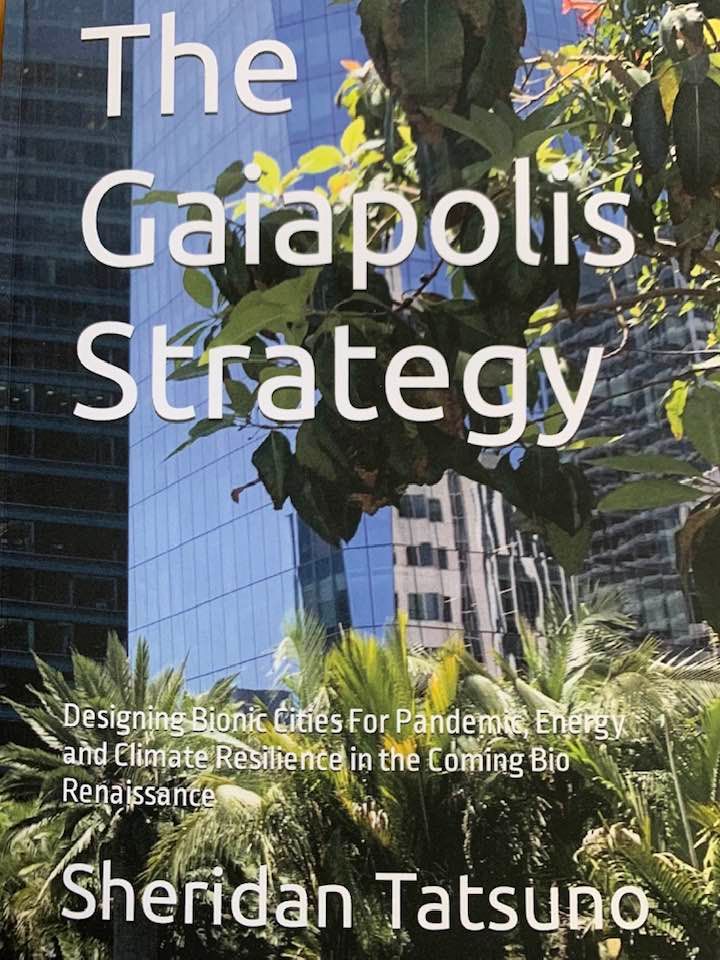
To assist in our global transition to a fairer, greener economy, I just published “The Gaiapolis Strategy: Designing Bionic Cities for Pandemic, Energy and Climate Resilience in the Coming Bio Renaissance”, which provides an 8-year roadmap for urban decarbonization so we can reach our 2030 climate goals. See: shorturl.at/MWY35

What are bionic cities? They combine biomedicine, green cities, smart cities, and exponential technologies (VR/AR, AI, IoT, blockchain, NFTs, etc.), where the new green jobs are already emerging. We need holistic solutions that address our health and the planet so bionic cities will integrate the environment (macrobiology) with our bodies (microbiology) since both affect each other, as pandemics and climate changes have shown. Essentially, we need to design greener, healthier cities capable of thriving despite climate disasters.

Why now? Due to the failure of nations to address climate change, I believe citizens and local governments — cities, towns and bioregions — should take charge and become our climate leaders. It’s already happening. Here’s a list of cities:

Current #urban #climate initiatives 

https://www.linkedin.com/pulse/urban-decarbonization-1-sheridan-tatsuno/?trackingId=MEVMDZTeSEuGABCMQJu48Q%3D%3D

To help citizens and cities jumpstart and finance their climate projects, I wrote this article:

Decarbonization: How Cities Can Become Our Climate Leaders

https://www.linkedin.com/pulse/decarbonization-how-cities-can-become-our-climate-leaders-tatsuno/?trackingId=ChffQlveSeOVCAe%2BgrzNAQ%3D%3D

My book is the launch of many climate actions that I’ll be promoting and supporting over the coming years. By the way, my book has a chapter about how VR/AR, AI, blockchain and other exponential technologies can accelerate local climate action.

Let me know what you think and feel free to share this article!

Sheridan, @sheridantatsuno